Welcome In, now showing in the Epistemologies Of Slop show in San Francisco
Welcome In is a greeting in the age of free slop, a programmatic greeting with a performance component. It just went up at Tiat and is on display through the end of July 2026.
A tiny computer watches from a camera, when you walk by and show your face it lights up and identifies your clothing and writes on screen a hello and a compliment on your appearance and a welcome to the gallery, and prints out a response to a question that inspired the exhibition and prints that out, I ask you to buy it for a dollar, if you don’t buy it I crumple it up in front of you and throw it into a burgeoning trash can surrounded by bags of similar trash. What happens to us when words that mean nothing to no one are infinite and free? How many greetings will you buy? Can you tell whether/how the LLM output has been tampered with?
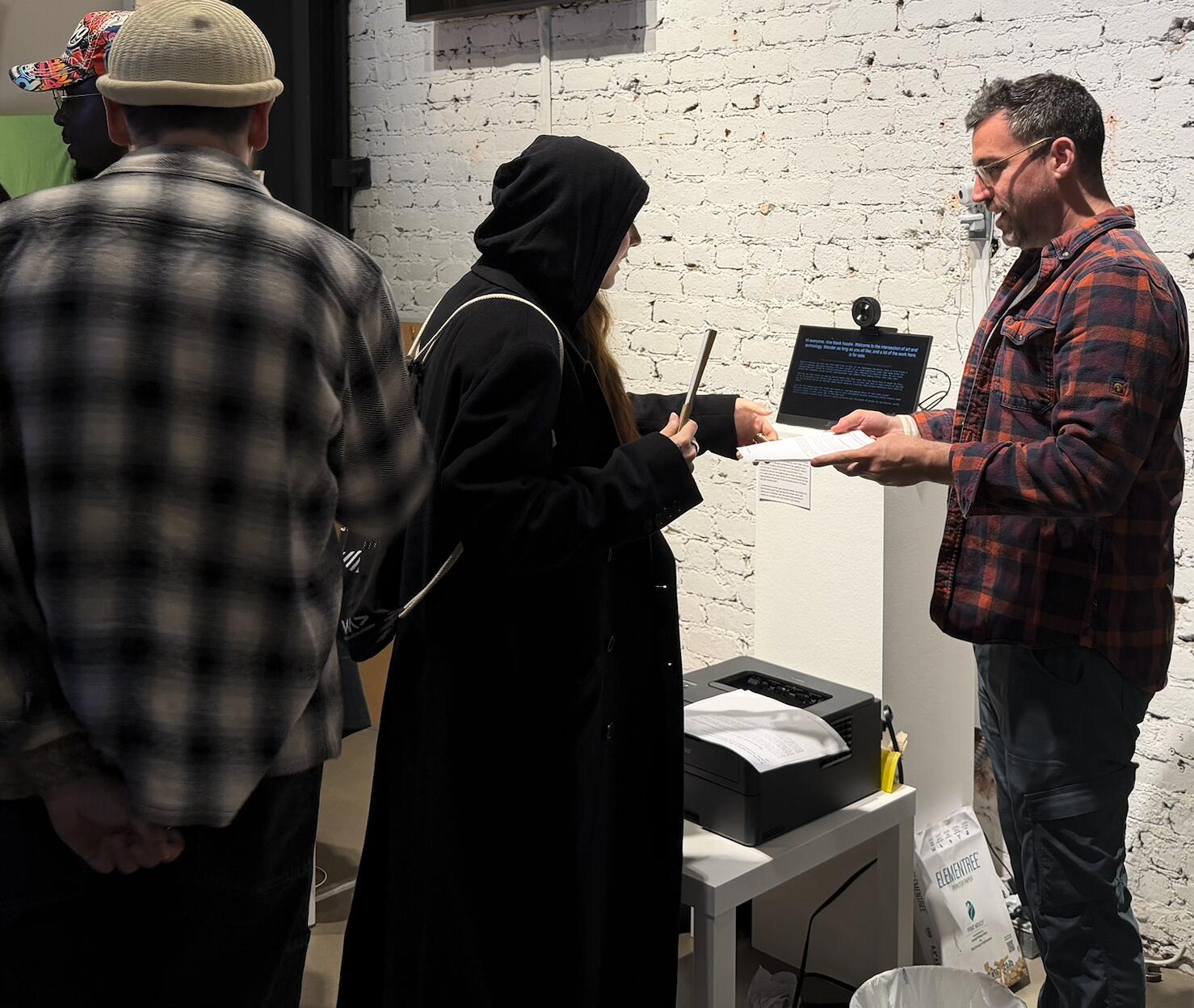
This started life as a desktop app running in Python, and I’ve also made a webapp rendition.
To me, slop feels:
- monetized
- uncomfortably abundant
- added furtively, out of place
- recognizable, with a particular grain
- seemingly useful at first glance
- fast, easily at hand
- ultimately unfulfilling and disrespectful of time
- minimally viable
It was exciting to see people engage with the piece.
A lot of people saw Welcome In perceiving other people, and were excited to be perceived correctly for their clothing and the color of it, just a few dimensions, a minimally viable recognition, and even waited for the sequence to complete from the last run to be recognized.
The printer would print continuously if you were looking into the webcam, so keeping up with throwing all of the paper out ended up being quite a time intensive ordeal. (When throwing out paper, I would fold the paper to keep all the text facing outwards before crumpling, so that no matter how it landed it the trash it looked like there was lots of text getting thrown out.)
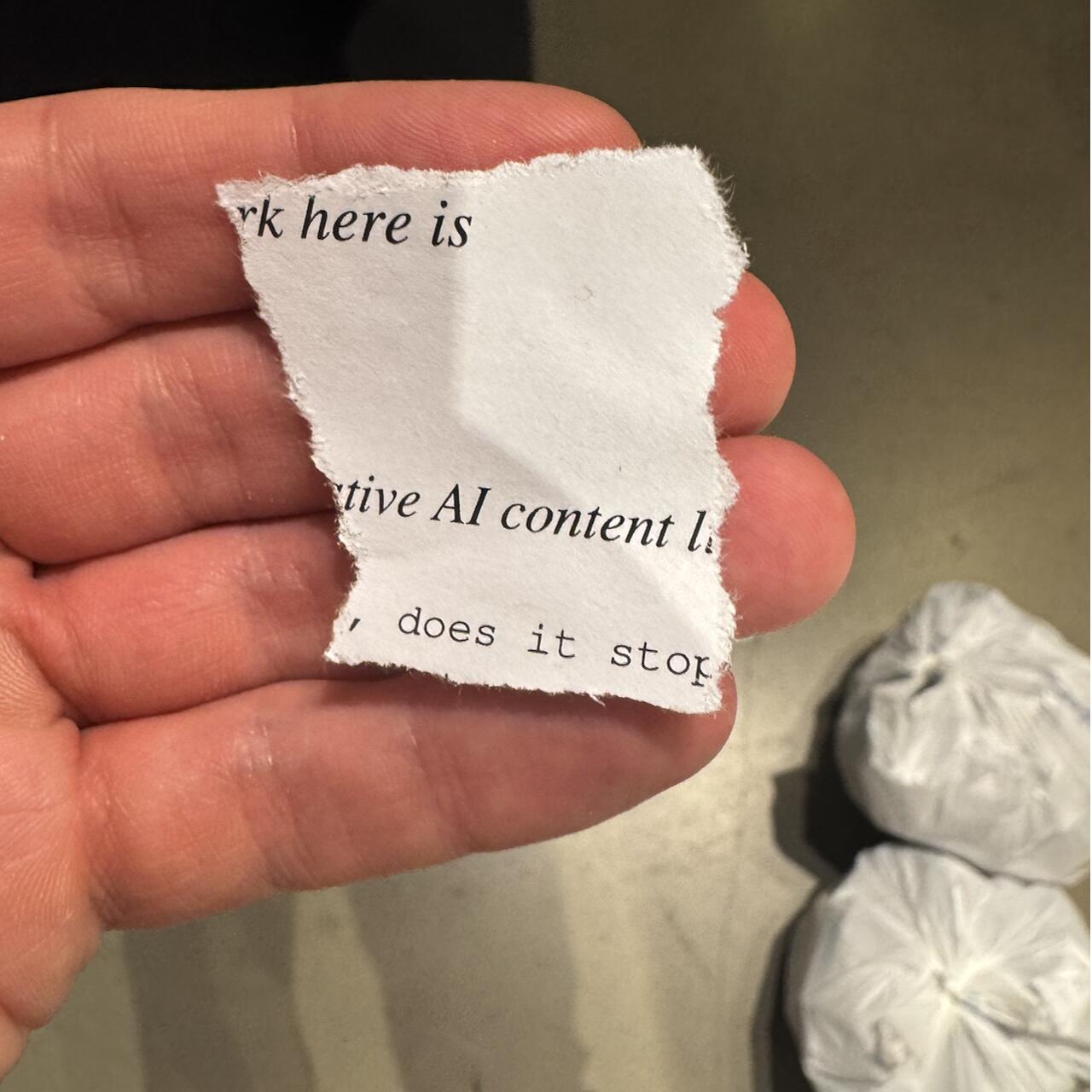
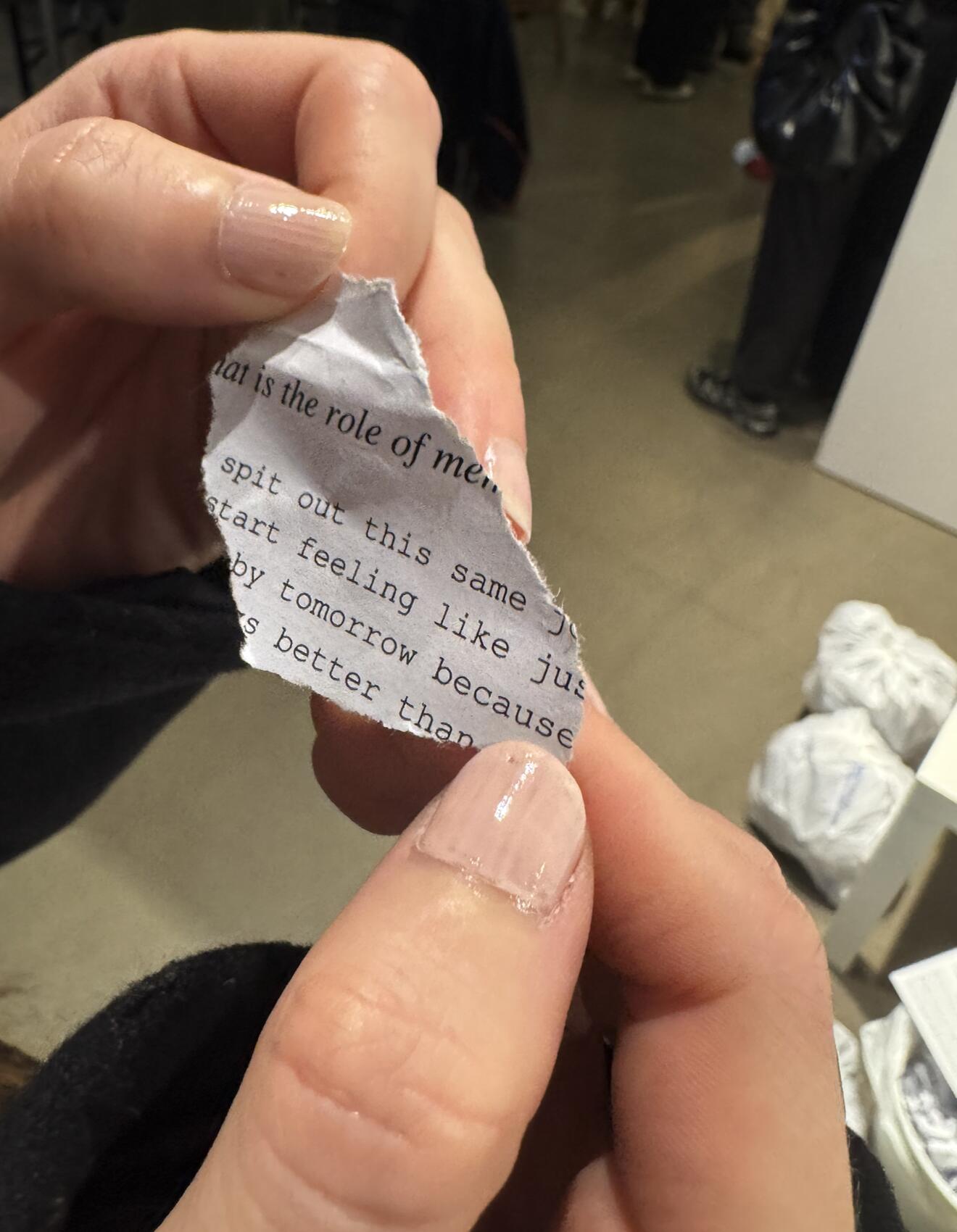
People immediately reacted to being asked if they’d buy it for a dollar. Some folks paid, lots didn’t pay, someone answered my question of “Would you buy this for a dollar?” with “Yes, I would buy it for a dollar, I will not give you a dollar now”, someone offered to pay in receipts from their piece which used a receipt printer, and, my favorite, someone tore up the extra printouts on the printer and made erasure poetry:
here is AI content does it stop
spit out this same feeling like tomorrow
Many participants were naturally curious about what was running, and mesmerized that it was all local to the Pi. “Qwen” made someone’s ears perk up. First was a face detector served as a visual wake word. Then there was a CLIP-style model to embed image and text into a shared embedding. We had five different types of compliments, is the image embedding closer to the text embedding of “one” versus “many”, which text embedding of “red”/”green”/”blue”/etc is the image embedding closest to for determining color, which text embedding of “t shirt”/”dress”/etc is the image embedding closest to for describing your outfit, and we can make several hundred different greetings by gluing a few strings together and it feels much more personal than it actually is and it is very cheap to generate. In addition to the personalized greeting there was slop text answering a question that inspired the exhibition, rendered by Qwen in a constrained generation with an acrostic (spelling out SLOP TIAT LEEB).
Someone was very concerned about the visible paper waste being bagged up in front of the piece. A ream of paper weighs about 3 kilos, and a kilo of paper takes about 6 kWh to make and embodies 5 kWh, and a modern GB300 consumes 1.4 kW, so the energy of that printed sheet of text is about the energy of running a new GPU for a few minutes, a few responses of from a chatbot.
Someone had said “there’s not enough time to make meaning out of it”. Such is the feel of slop.
Someone had said “oh no it’s printing, I hope that wasn’t me”, as if their individual choices could unplug the raspberry pi and power down the laserjet printer.
A lot of people were excited to receive the first page, many people were recitent to buy one, almost no one wanted to buy three or more pages.